


Lamborghini LM002: The Story of the Original Rambo Lambo
The LM002 was the first SUV ever built by Lamborghini. Between 1986 and 1992, only 301 left the factory, making the original Rambo Lambo one of the rarest and most coveted Lamborghinis on the collector market today.

Before the Urus, Lamborghini built a war machine. The Lamborghini LM002, also known as the Rambo Lambo, was the first Lamborghini SUV ever to reach production. It put a 5.2-litre V12 from the Countach into a 2.7-tonne off-roader, sold 301 units between 1986 and 1992, and ended up in the garages of kings, dictators, and rock stars. The LM002 vs Urus debate starts here: this is the truck that made the Urus possible decades later.
Lamborghini LM002 Specs at a Glance
How It Started
In 1977, a small American defense contractor called Mobility Technology International approached Lamborghini with a proposal. MTI wanted a factory-built all-terrain vehicle with military applications. What emerged from Sant'Agata was the Cheetah: a low, aggressive prototype with a rear-mounted Chrysler V8 and the raging bull on the hood. Legal disputes killed it before the US military ever officially tested it. The only example built was later destroyed in a crash stateside.
That should have been the end of Lamborghini's off-road ambitions.
It wasn't.
The LM001 followed, still rear-engined, still plagued by the weight distribution problems that made serious off-road work nearly impossible. The third attempt changed everything. Engineers moved the engine to the front, swapping the American V8 for the Countach's 5.2-litre V12. A tubular steel chassis, riveted aluminum body, and a proper four-wheel-drive system with a two-speed transfer case went underneath it.
The prototype, called the LMA002, debuted at Geneva in 1982. The production version arrived at Brussels in January 1986.
The LM002 was both the first SUV Lamborghini ever built and the first four-wheel-drive Lamborghini to reach production: a configuration that wouldn't appear in the road car lineup until the Diablo VT, seven years later.
How Fast Is the Lamborghini LM002?
The numbers take a moment to process.
Curb weight: 2,700 kg. Nearly three tonnes. The V12 produced 444 horsepower, more than the Countach, partly because emissions regulations for "light trucks" were less stringent than for passenger cars. Zero to 100 km/h came in 7.7 seconds. Top speed on tarmac exceeded 190 km/h. Fuel economy: roughly 35 litres per 100 km. The tank held 169 litres.
The transmission was a heavy-duty ZF five-speed manual, and the four-wheel-drive system allowed operation in low range, high range, and conventional rear-wheel drive. Front hubs were manually locking.
Tires Built From Scratch
Pirelli had to develop a tire from scratch. Nothing in their existing catalogue could handle the combination of desert heat, the load, and the speeds this vehicle was capable of, while also running safely on a deflated carcass. So Lamborghini commissioned them to build something entirely new.
The result was the Scorpion BK. What made it unusual, beyond its sheer size, was a set of lateral winglets on the sidewall (known internally as "ears") designed to give the car flotation and directional response on loose sand. The tread pattern itself was derived from the intermediate Monte Carlo pattern used on Pirelli's rally slicks of the era, and the carcass was built with aramid anti-cut reinforcement, borrowing construction techniques directly from motorsport. It was one of Pirelli's earliest examples of race-to-road technology transfer, and it was produced in two distinct tread configurations: one for mixed road and off-road use, one for sand only. Size: 325/65 or 345/60 on 17-inch wheels.
It's no coincidence that Pirelli fitted Scorpion tires to several Paris-Dakar entries in 1988, including the factory LM002 competition cars.
Those original tires were nearly impossible to source for decades. In June 2023, Pirelli reissued the Scorpion BK as part of their Collezione range, a program dedicated to recreating period-correct rubber for significant historical cars. The reissue was unveiled at Fuori Concorso on Lake Como, fitted to a private collector's LM002, with Lamborghini Polo Storico present.

Build, Interior, and Coachwork
The rear section of the truck was designed as an open observation deck. In the military configurations Lamborghini had initially hoped to sell, this area would carry armed personnel. In the civilian version, it accommodates additional passengers and features a removable storage unit that lifts out, freeing the deck for cargo or passengers depending on the mission.
The interior was full Lamborghini specification: four leather seats, thick carpeting, tinted power windows, air conditioning, and a special Alpine 7235 stereo mounted in the roof console, easily identifiable with a unique cover to keep sand out of the tape deck mechanism. The bodywork wasn't actually built in Sant'Agata. Lamborghini contracted the Irizar coachbuilding factory in the Basque Country for fabrication, with final assembly returning to Italy.
Famous Lamborghini LM002 Owners
The military orders never arrived at scale. A rumoured 40-unit Saudi army contract, a reported Libyan deal: neither was ever confirmed, and some sources suggest no military-specification LM002s were formally delivered at all, though certain examples were fitted with custom roof panels featuring twin trap doors above the rear seats.
What did arrive were civilian buyers, and the list tells its own story.
King Hassan II of Morocco took delivery of the first production unit. Keke Rosberg ordered one. Malcolm Forbes specified his personal money green. Sylvester Stallone, Tina Turner, and Van Halen followed. So did Mike Tyson, Pablo Escobar, Muammar Gaddafi, and Uday Hussein, whose example was seized by US forces in Iraq and detonated in 2004, officially as a car bomb test. When Bashar al-Assad's compound in Damascus was opened after his fall in 2024, a red LM002 was visible in the vehicle collection stored inside the Presidential Palace.
The Paris-Dakar Attempt That Almost Happened
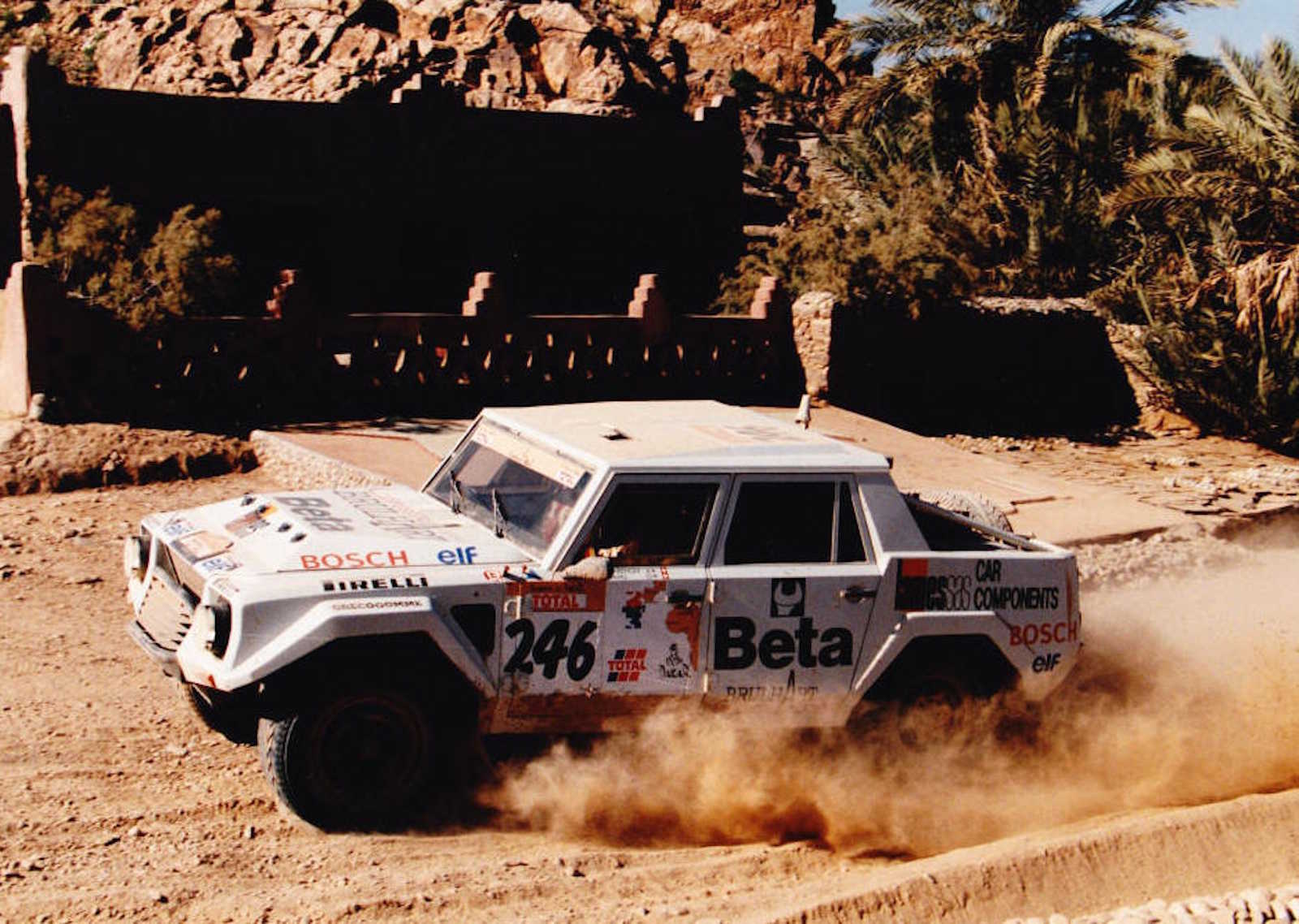
Two examples were built to competition specification in 1988 with the intention of entering the Paris-Dakar Rally. One white, one orange. The white car had its engine taken to 600 PS, stripped of unnecessary weight, fitted with a full roll cage, plexiglass windows, and GPS equipment. Funding ran out before a formal Dakar entry could be confirmed.
Sandro Munari did campaign the car in the Rallye des Pharaons in Egypt, and again in the Rally of Greece. In Greece, a high-speed desert stage where the LM002 was expected to perform strongly was removed from the route before the car could complete it. Munari withdrew. Before that decision, the results had been strong.
End of Production
Production ended in 1992. Total output: 301 units, of which the final 60 were the LM/American edition, introduced at the 1990 Detroit Auto Show. These cars came with special badging and body stripes, an upgraded interior, ground effects side skirts, chrome front and rear bumpers, and MSW/OZ Racing alloy wheels, all fitted with the fuel-injected 5.2L Diablo V12.
Lamborghini claimed to have orders for around 800 cars. The hand-built manufacturing process made filling them impossible without pulling the factory away from the Countach and Diablo. They chose the more profitable path.
Fewer than 300 LM002s are believed to survive.
Collector Status Today
The LM002's reputation has flipped completely. What was once seen as an oddity, a Lamborghini that didn't quite fit the brand, is now one of the most desirable Lamborghinis on the planet. Hand-built, V12-powered, manual-only, and a confirmed first: the first Lamborghini SUV, the first production four-wheel-drive Lamborghini, and the spiritual ancestor of everything Sant'Agata builds in the SUV space today.
Compare the numbers: the Urus sells in the range of 5,000 to 8,000 units a year. The LM002 produced 301 units across six years. That scarcity, combined with the Diablo V12 in the final cars and the Rambo Lambo cultural footprint, is what's driving values. Pristine, documented examples have changed hands at major auctions for figures well into the high six figures, with exceptional cars pushing further.
If you're shopping one, the things that move the needle are: original paint, manual transmission (they all are, but verify), documented service history, the LM/American edition badge, and provenance. A famous prior owner can add a multiplier all on its own.
The Bottom Line
The Lamborghini LM002 was a commercial misfire and a historical landmark at the same time. It didn't sell to the militaries it was designed for. It didn't finish Paris-Dakar. None of that matters anymore. What matters is that it was the first Lamborghini SUV, the only V12 off-roader the company ever built, and the foundation the Urus eventually stood on.
If you're hunting for one of these cars or want to know what to look for before you buy, the Curated team knows these cars inside and out. Get in touch and we'll walk you through it.
Lamborghini LM002 FAQ


.webp)
