


Why the Porsche Carrera GT Still Defines What a Supercar Should Be
With only 1,270 units ever built, the Carrera GT is a time capsule from an era when manufacturers still trusted drivers with 612 horsepower and a grabby ceramic clutch.

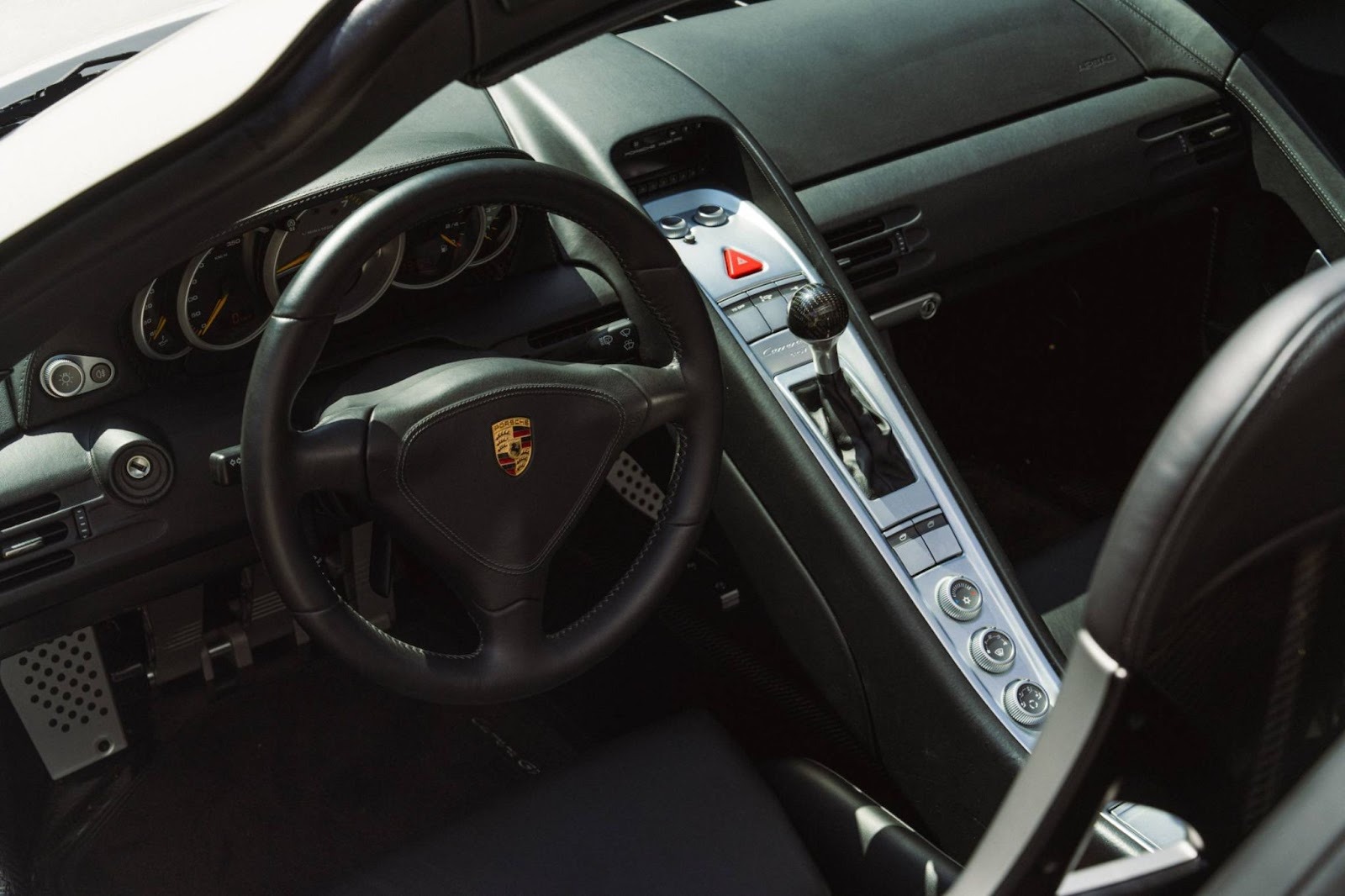
Turn the key to the left of the steering wheel (a quirk born from Le Mans running starts) and the Carrera GT wakes up with mechanical precision. The ceramic clutch engages in the final inch of pedal travel. Feed the throttle and the 5.7-liter V10 responds with a shriek that climbs towards 8,000 rpm. That's the start of a conversation between the car and its driver, conducted in the language of vibrations, feedback, and raw mechanical honesty.
The Porsche Carrera GT may be seen by some as an anachronism. But it’s not! This supercar represents the final chapter of a motorsport heritage unleashed on public roads, a bridge between racing prototypes and street-legal supercars that will likely never be built again. For collectors and purists, this is a rare supercar that demands everything from its driver and rewards those who are up to the challenge.
How The V10 Porsche Was Nearly Shelved
Did you know that the Carrera GT's engine nearly died before it ever hit public roads? Its story began not in a design studio, but on the drawing boards of Porsche's racing division in the late 1990s. The company had its sights set on Le Mans glory with the LMP 2000 prototype, a car that would carry a revolutionary engine: a compact, water-cooled 5.5-liter V10 derived from a unit Porsche had secretly developed for the Footwork Formula One team in 1992.
Weighing only 165 kilograms and designed to accelerate to 8,900 rpm, the V10 embodied everything Porsche knew about motorsport engineering: high-revving, stable, and utterly uncompromising. But in early 1999, corporate realities came into play. Porsche cancelled the LMP 2000 project as part of a wider Volkswagen Group strategy that enabled Audi to dominate Le Mans while Porsche concentrated on series production vehicles, such as the Cayenne SUV.
It would have been the end of the story for most manufacturers. Racing engines gather dust in corporate archives, monuments to what could have been. But Porsche's engineers recognized that they had created something too exceptional to abandon. As Roland Kussmaul, former test driver and engineer at Porsche AG, explained: "We had an engine that was built for the extreme – so we gave it a new challenge: everyday life. The LMP 2000 was our vision for the future. The Carrera GT put our ideas on the road."
Resurrecting the V10 in a road car was a statement of philosophy! In September 2000, Porsche unveiled a concept version at the Paris Motor Show, where two-time World Rally Champion Walter Röhrl drove the open sports car through rain-soaked streets from the Arc de Triomphe to the Louvre. The auto world was captivated by the spectacle, and Porsche was persuaded to greenlight production. The strong interest and good revenue from Cayenne sales played a role in this decision, too.
"The Carrera GT is an essential element of our philosophy: taking motorsport seriously, understanding origins – and translating these into motion," Kussmaul noted.
Exceptional Engineering

Building a road-legal car around a Le Mans engine required an obsessive attention to materials science and weight distribution. Porsche partnered with ATR Composites Group of Italy, the same company that produced the Ferrari Enzo's chassis, to create a full carbon fiber monocoque. The construction process involved placing approximately 1,000 pieces of carbon fiber cloth on molds, vacuum-bagging them to eliminate air bubbles, and then curing them under high temperature and pressure in an autoclave.
Carbon fiber is present throughout the vehicle with almost fanatical consistency. Surprisingly, each seat weighs just 23 pounds, which is half the weight of a 911 seat. The wheels are made of forged magnesium and weigh about a third less than conventional aluminum rims. The engine oil tank was inserted directly into the transmission housing, and oil passages were routed internally, eliminating the need for external lines. Additionally, titanium connecting rods helped reduce reciprocating mass in the engine, while aluminum replaced steel in the upper control arms and front crush structure.
These weight-saving measures reveal Porsche's approach: every gram matters when pursuing the perfect power-to-weight ratio. Yet paradoxically, the Carrera GT weighs 3,146 pounds, nearly identical to a Corvette Z06 from the same era. Michael Hölscher, the project manager, explained that adding additional structural reinforcement was necessary to achieve proper chassis stiffness in an open-top configuration. The removable roof panel, while providing the visceral open-air experience, demands a more robust tub.
Then there's the cooling system. A bank of three large radiators fills the nose of the car, roughly five times the size of a contemporary 911 Turbo's radiator. "It will never overheat," Hölscher pledged. Add approximately 40 pounds of filler to give the carbon fiber body its durable, glossy finish, air conditioning for those who actually drive their cars, and general reinforcement to handle 605 horsepower, and suddenly the weight makes sense.
Porsche's racing pedigree is further demonstrated in the suspension design. Instead of rubber bushings, which filter road noise but allow for minor deflections, the control arms mount to the chassis via spherical bearings. This provides unfiltered feedback from the road surface. Every crack and undulation transmits through the chassis with crystalline clarity. The experience on the road is intense. On track, it's transformative, providing a continuous stream of information to the driver.
The V10

At the core of the Carrera GT experience lies that rescued racing engine, now enlarged to 5.7 liters and producing 612 horsepower at 8,000 rpm with 435 pound-feet of torque arriving at 5,750 rpm. The power delivery approach reflected by these numbers is fundamentally different. Modern turbocharged engines deliver torque at low rev ranges and plateau early. The Carrera GT's naturally aspirated V10 is a demanding engine that builds power progressively as the tachometer moves towards redline.
The sound alone justifies the car's existence. As Car and Driver documented during their 2004 test, the engine registers 93 decibels at full throttle. This is raw and mechanical, more akin to a Formula One car than a street machine. The aluminum block and heads, variable valve timing on the intake camshafts, and sodium-cooled exhaust valves all contribute to an engine that feels eager to rev.
Then there's the clutch, the Porsche Ceramic Composite Clutch (PCCC), that separates novices from those truly committed to the Carrera GT experience. The ceramic dry clutch engages in maybe the final inch of the pedal's travel on the floor. It’s actually a feature! The clutch requires smooth, practiced inputs. If you master it, the reward is an immediate and direct connection between intention and action. The high-mounted shifter is directly connected to the six-speed manual transmission by flat steel rods, which provides satisfying mechanical feedback.
Despite its race-derived ferocity, the engine proves to be quite flexible. The Carrera GT is able to accelerate from 5 to 60 mph in just 3.7 seconds during testing. Even in sixth gear at 1,200 rpm, it can pull from 30 to 50 mph in 4.3 seconds and from 50 to 70 mph in 4.8 seconds, which is comparable to many contemporary supercars.
Technical Specs
The Carrera GT's specifications reveal a vehicle optimized for both speed and driver engagement:
Driving the Legend
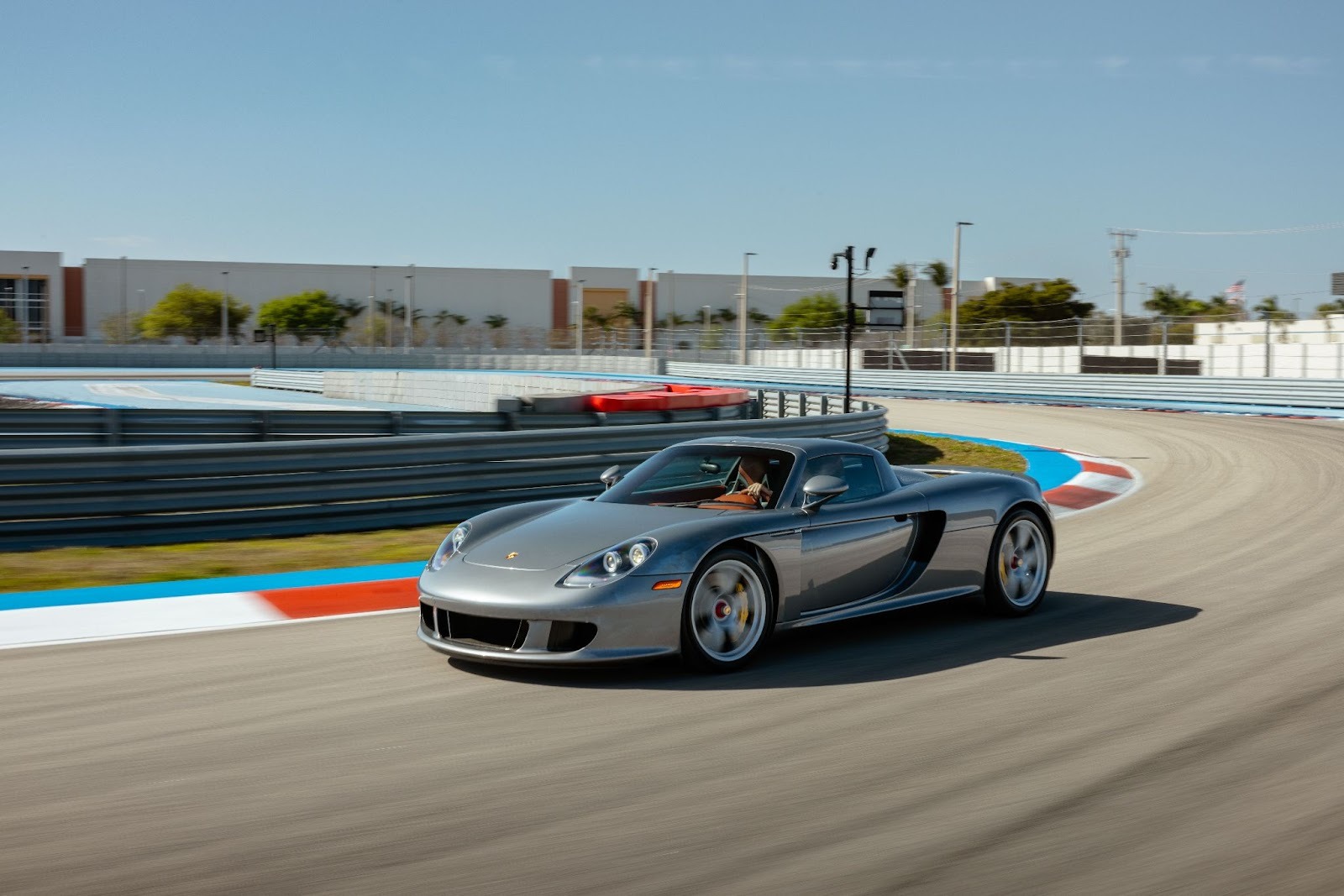
The Carrera GT provides an honest, unmediated conversation with the driver, often conducted at speeds where mistakes should be avoided.
Walter Röhrl, who helped tune the chassis, understood it perfectly: "The Carrera GT driver wants to be challenged, but not overwhelmed." The goal was creating a car that rewarded skill without punishing occasional imperfection. Röhrl, Kussmaul, and their team succeeded in making the Carrera GT suitable for everyday use.
But the Carrera GT's true nature is revealed on the track. The Car and Driver test team recorded 1.10G in slow corners and 1.19G in faster sections, where aerodynamic downforce from the adjustable rear wing and underbody diffusers enhanced grip. The steering provides perfect feedback. It is power-assisted but unvariable with speed, building effort naturally as cornering loads increase. You always know precisely how much grip remains before the tires start protesting.
The suspension's spherical bearings, annoying in traffic, become invaluable at high speeds. As the test team noted: "We tried, but we never found a way to upset the chassis. It's simply glued to the road." During testing at Italy's Adria International Raceway, drivers approached a tight hairpin at 135 mph, a horror-inducing speed. Instead, the GT's excellent handling and tremendous grip made difficult maneuvers feel manageable.
The chassis' capability is matched by the braking system. Porsche's Carbon fiber-reinforced Silicon Carbide (C/SiC) ceramic composite system, with 15-inch discs gripped by calipers inside 19-inch front and 20-inch rear wheels, stops the car from 70 mph in just 145 feet. The pedal stays firm, enabling precise trail braking into corners.
The Nürburgring provides the ultimate test, and the Carrera GT posted a 7:28 lap time, which is extraordinary for 2004. In 2024, an updated run achieved 7:12, demonstrating the car's enduring capability and the advancement of tire technology.
Collector Perspective
Limited production resulted in instant collectibility for the Carrera GT. Porsche originally planned 1,500 units, but cited the changing airbag regulations in the United States as a reason to end production early. By May 6, 2006, only 1,270 examples had been hand-crafted in Zuffenhausen and Leipzig, Germany. Of these, 644 went to the United States, 31 in Canada, and 49 in the United Kingdom.
It's not about planned obsolescence, but rather a production limitation. Extensive hand-finishing was necessary for every carbon monocoque. The assembly couldn't be rushed. The result: a supercar that is rare enough to feel special yet common enough to make finding one still possible.
The 2023 recall, while concerning to owners, actually demonstrates Porsche's continued commitment to the platform. The issue involved spherical suspension joints that could weaken from corrosion and mechanical stress over time, particularly in regions using road salt during winter. All 489 U.S.-market Carrera GTs from the 2004 and 2005 model years were recalled for inspection.
It took more than a year to implement the remedy because sourcing parts for a 20-year-old limited production car proved challenging. Porsche's solution was more than just replacing defective components. Owners received $3,240 in complimentary maintenance to bring their supercars back to proper roadworthiness after extended storage, recognizing that rubber seals and fluids degrade when cars are left unused. Additionally, every owner received a fresh set of Michelin Pilot Sport Cup 2 N-Spec tires (265/35R19 front and 335/30R20 rear), even if their suspension passed inspection.
The performance of these modern compound tires is significantly improved over period-correct rubber. This factory support for a discontinued model helped strengthen Porsche's reputation for standing behind their products decades after production ended.
Today, the Carrera GT occupies a unique moment: before electronic driver aids became mandatory, before hybrid powertrains dominated supercar development, when a manufacturer could still build an uncompromising car and trust drivers to handle it.
As a result, ultra-low mileage examples may command premium prices. Original condition, documentation and service history will enhance their collectibility significantly.
Why the Carrera GT Still Matters
The Carrera GT's significance is only becoming more evident a quarter-century after its Paris debut. Exterior designer Anthony-Robert "Tony" Hatter understood the Carrera GT's significance: "This car is a gift to everyone who wants to know where Porsche came from – and where we want to go. We took motorsport in its purest form – and made it into a road car." That philosophy, which translates racing engineering directly into street cars without dilution, defined Porsche's golden era.
The Carrera GT embodies design restraint in an era of excess. No unnecessary aerodynamic flourishes. No aggressive styling meant to intimidate. The form follows function with Germanic precision: the large side inlets feed the V10, the rear wing deploys at 70 mph for aerodynamic stability, the diffusers manage underbody airflow. Beauty emerges from purpose, not decoration.
Consider what came after: the 918 Spyder, technically superior but fundamentally different with its hybrid powertrain and electric motors filling torque gaps. The 918 can lap the Nürburgring faster, accelerate harder, brake shorter. Yet it lacks the Carrera GT's unfiltered character. One is undeniably faster; the other is arguably more memorable.
Collectors and enthusiasts understand that automotive history has inflection points: moments when one approach ends and another begins hold significance. The Carrera GT sits at that inflection point, representing the final expression of mechanical excellence before electronics became mainstream. It's not better or worse than anything that came after, it's just different and becoming increasingly rare.
Our Team’s View
At Curated, we acknowledge that certain models go beyond their function as transportation and become cultural artifacts. The Porsche Carrera GT represents this transformation in a way that is more complete than any other modern supercar.
We approach these cars not as commodities to be bought and sold for profit, but as treasures deserving preservation and understanding. Each Carrera GT tells a story: about Porsche's racing heritage and about the relentless pursuit of mechanical perfection.
Standing next to a Carrera GT (in Guards Red or Fayence Yellow) creates an immediate impact. The low stance, the sculpted body, and the way light plays across carbon fiber surfaces all contribute to an aura that photographs cannot fully capture. The knowledge of what lies beneath that body, including the racing-derived V10, the hand-laid carbon monocoque, and the titanium and magnesium components, adds a high level of intellectual appreciation to the visual impact.
For those fortunate enough to own one, the Carrera GT offers something rare: genuine connection. On the road, this car demands your full attention, rewards your skill, and grudgingly forgives your mistakes. This car is not meant for casual driving; it requires commitment and provides satisfaction proportional to the effort put in.
About Curated
Curated is a premier platform dedicated to the world of exceptional automobiles and the collectors who cherish them. Our focus is on connecting car enthusiasts with rare, significant, and historically important vehicles while also providing the context, knowledge, and appreciation that these machines deserve.
Whether you're an established collector, an aspiring enthusiast, or simply someone who appreciates automotive excellence, Curated offers a thoughtfully curated experience. We celebrate cars as cultural artifacts, engineering achievements, and artistic expressions.



.webp)
